
The Real Cost of Manual Competitor Tracking (It Is Not Free)
Synopsis
Quantifies manual tracking costs across three dimensions: time, missed intelligence, and reactive decisions. Calculates time cost per quarter with dollar value. Positions Palrox's Starter plan as cheaper than two hours of a founder's time.
The Illusion of Free
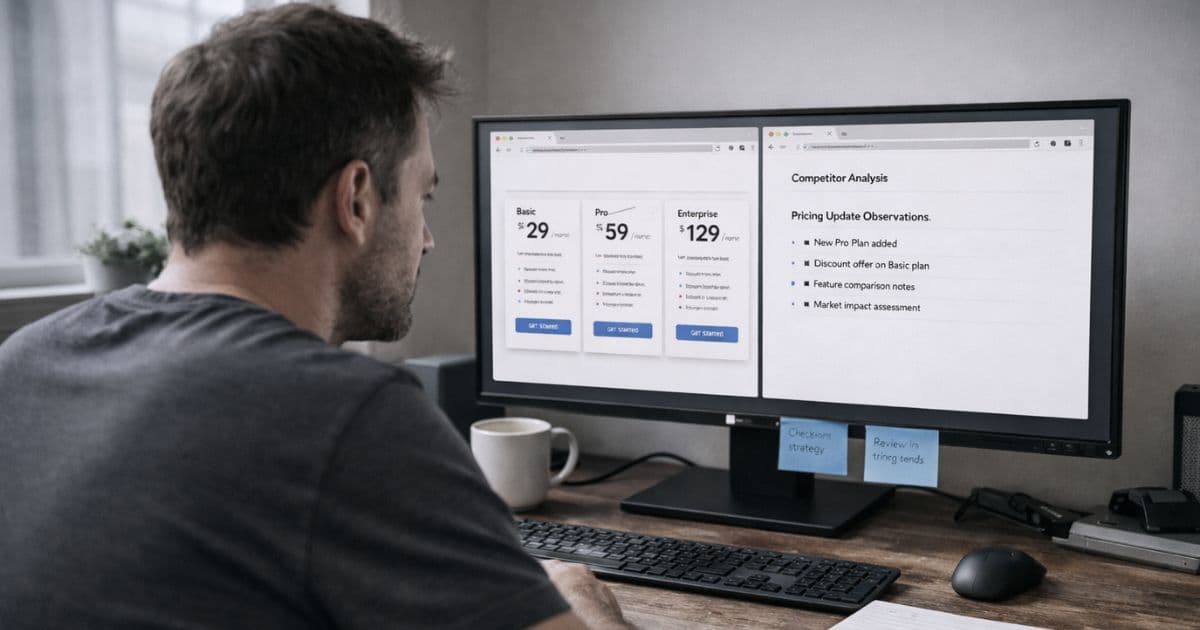
Manual competitor tracking feels free. Nobody invoices you for it. It does not show up as a line item in your budget. It is just something people do when they have time, which is exactly the problem.
The real cost of manual competitor tracking is not zero. It is invisible, which is harder to manage than expensive.
32 hours per quarter. That is what five competitors costs at two manual checks per week. Pagezii's Starter plan is $87 per quarter.
When you add up the time, the missed signals, and the downstream decisions made without the right information, manual tracking is one of the more expensive processes most early-stage companies run without realizing it.
The Time Cost
Start with time. A realistic manual tracking routine across five competitors looks like this:
Checking pricing pages for five competitors: 10 minutes. Checking features pages: 15 minutes. Scanning homepages for messaging changes: 10 minutes. Skimming blog pages for new posts: 20 minutes. Documenting anything notable: 15 minutes. Total: roughly 70 minutes per session.
Most teams overestimate how often they actually check. Pull your calendar. The last time you reviewed all five competitor sites was probably longer ago than you think.
Most teams do this two to three times per week when they are being diligent. At two sessions per week, that is 140 minutes, or roughly 2.5 hours per week.
Over a quarter, that is approximately 32 hours per person. If the person doing it is a founder or senior product lead at an effective hourly rate of $150, that is $4,800 per quarter in time cost — just for the checking.
That number does not include the time spent reacting to signals that were caught late. It does not include the time spent in sales calls managing surprises that earlier information would have prevented.
Palrox's Starter plan is $29 per month. That is $87 per quarter. The math is straightforward.
The Missed Intelligence Cost
Time is recoverable. Missed signals are not.
The most expensive part of manual tracking is not what it costs in hours. It is what it costs in information quality. Specifically, the cost of making decisions without signals you should have had.
Three examples of missed intelligence that carry real costs:
A competitor drops their pricing on a Tuesday. You find out the following Thursday when a prospect mentions it in a demo. You lose a deal you might have kept if you had been able to brief your sales team two days earlier.
A competitor launches an integration with a tool your prospects use. You find out three weeks later from a customer. In those three weeks, the competitor has published supporting content, gotten reviews, and built it into their sales pitch. You are three weeks behind in a conversation you did not know you were having.
A competitor pivots into a new product category and publishes early content about it. You find out two months later. By then, they have organic rankings, backlinks, and a sales narrative that is two months more developed than yours.
Each of these is a cost that does not show up in a budget. But each one is real.
For a first-person account of what three specific missed signals cost over six months, read manual competitor tracking mistakes.
The Reactive Decision Cost
The third cost is the hardest to measure: decisions made reactively because the intelligence came too late.
A roadmap quarter planned without knowing a competitor was building the same feature. A pricing structure set without knowing a competitor had just dropped theirs. A go-to-market plan built without knowing a competitor had just entered your primary market.
The gap between proactive and reactive is usually just one missed alert. Earlier signals do not guarantee better decisions — they guarantee more options.
Reactive decisions are not always wrong. Sometimes you respond to a competitive move and make a good call. But reactive decisions are made with less time, less context, and less optionality than proactive ones. The quality of your decisions goes up when you get signals earlier.
For how product teams use early competitor signals to make better roadmap decisions, read competitor monitoring for product roadmap protection.
What Automated Tracking Replaces
Automated competitor monitoring does not replace strategic thinking. It replaces the manual checking that should never have required strategic thinkers in the first place.
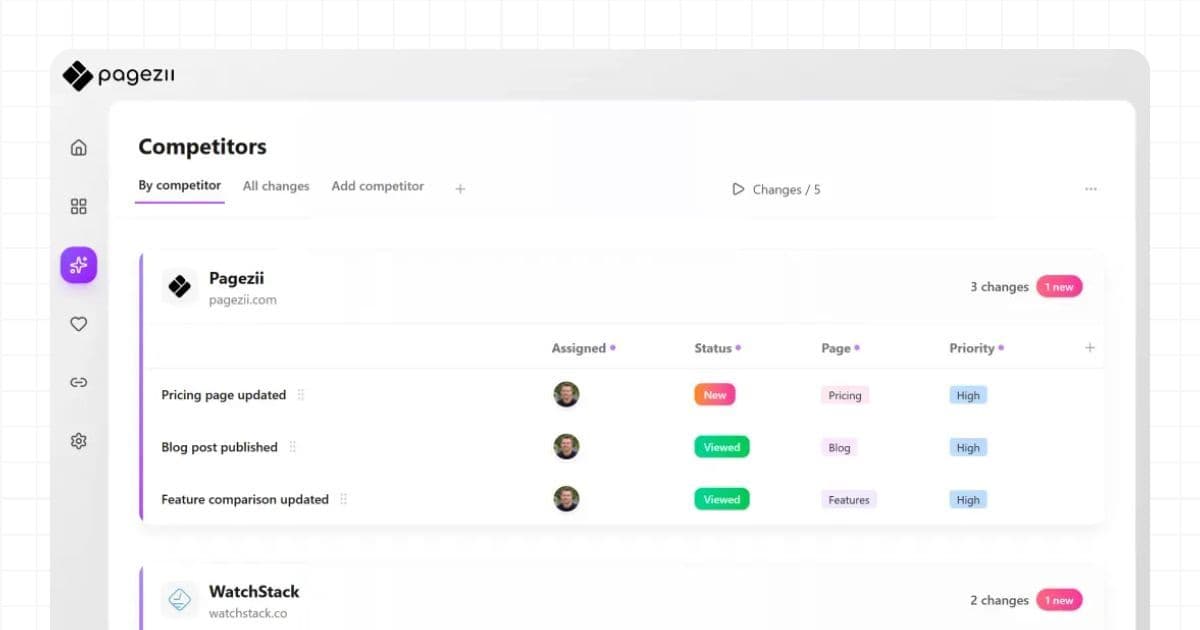
Palrox monitors pricing, features, homepage, blog, and product pages continuously. When something changes, you get an alert. Weekly summaries compile everything that changed across all tracked competitors into a single digest. Per-competitor reports give you a full history of changes over time.
The checking is handled. Your time goes to interpreting what the changes mean and deciding how to respond.
For a concrete look at what this workflow produces in the first 30 days, read automated competitor tracking: 30 days.
Making the Switch
The switch from manual competitor tracking to Palrox takes less than a day. You add competitor URLs, select pages to monitor, set alert preferences, and you are done. The full migration process is covered in detail in replace your competitor tracking spreadsheet.
Stop absorbing the hidden cost of manual competitor tracking and let Palrox do the checking for you.
About the Author

Jenna Gallo
Business Development
Jenna Gallo
Business Development
Jenna supports Pagezii’s business development, partnering with founders and teams while sharing insights on competitive intelligence and strategy.
Frequently Asked Questions
No. Manual competitor tracking costs time, which has a real dollar value. A founder or senior product lead spending three hours per week on manual checks is spending roughly 150 hours per year on a task that automated competitor monitoring handles for $29 per month.
Audience Context
For founders and operators who treat manual tracking as "free." They care because the real cost shows up in missed deals and reactive decisions, not line items.
Related Insights
- Manual Competitor Tracking Mistakes Founders Make — Real signals lost over six months of manual checks
- Competitor Monitoring for Product Roadmap Decisions — How product teams use signals earlier
- 30 Days of Automated Competitor Tracking Results — What you actually get in the first month
- Replace Your Competitor Tracking Spreadsheet Today — Migration from spreadsheet to automated alerts
- Is Pagezii Right for You? Company Stage Guide — Fit assessment by team size and stage
References
- Gilad, B. (2015, July 30). Companies collect competitive intelligence, but don’t use it. Harvard Business Review.
https://hbr.org/2015/07/companies-collect-competitive-intelligence-but-dont-use-it - Gilad, B., & Hoppe, M. (2016, June 15). The right way to use competitive intelligence. Harvard Business Review.
https://hbr.org/2016/06/the-right-way-to-use-competitive-intelligence - Olszak, C. M. (2023). Competitive intelligence as a lever of added value. Procedia Computer Science, 219, 1426–1433.
https://www.sciencedirect.com/science/article/pii/S1877050923013273 - Gupta, M., George, J. F., & Xia, W. (2021). Big data analytics in building the competitive intelligence of organizations. Information & Management, 58(3), 103384.
https://www.sciencedirect.com/science/article/abs/pii/S0268401220314304 - Venn Innovation. (2017, September 27). Information does not guarantee insight: How to use the competitive intelligence that you collect.
http://www.venninnovation.com/en/blog/2017/9/28/information-does-not-guarantee-insight-how-to-use-the-competitive-intelligence-t-you-collect
Disclaimer
This article is provided for informational purposes only. Pagezii aims to share practical insights on competitor tracking and market intelligence but does not guarantee completeness, accuracy, or specific business outcomes.