Is Palrox the Right Competitor Monitoring Tool for You? Honest Fit Guide by Stage
Synopsis
Honest fit assessment by company type: early-stage founders (strong fit), PLG companies (strong fit), enterprise with dedicated CI teams (supplement), agencies (moderate fit). Covers what each type gets and what the next step looks like..
The Honest Version
If you are evaluating a competitor monitoring tool for the first time, this post gives you a straight answer on whether Palrox fits your stage — including the cases where it might not.
Most tool comparison pages are written to convince you to buy. This one is written to help you figure out whether Palrox is the right fit for your specific situation — including the cases where it might not be.
Here is a straight assessment by company type.
Palrox is honest about who it is not for. That honesty is itself a signal about whether it is the right tool for you.
Early-Stage Founders: Strong Fit
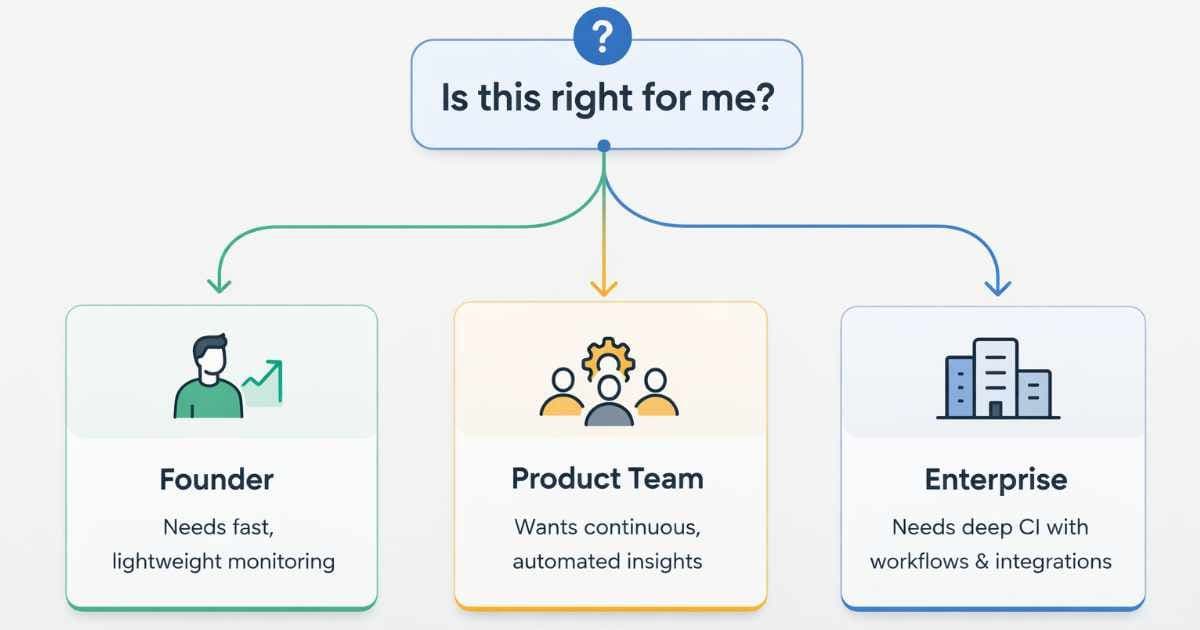
If you are a founder at a company with fewer than 50 employees, Palrox was designed with you in mind.
You have three to ten competitors worth watching. You do not have time to check their pages manually every week. You cannot justify an enterprise CI platform. And you need to know when something changes because you are often the person who has to decide what to do about it.
If you are a founder doing your own sales, set competitor alerts to email you directly. You want to know about a pricing change before your next call, not after.
Palrox's Starter plan at $29 per month covers three competitors across pricing, features, homepage, and blog pages. You get alerts when something changes and a weekly summary that takes 10 minutes to review. It is the minimum viable competitive intelligence setup for a company that is still finding and defending its market position.
The one thing Palrox does not replace at this stage is strategic analysis. Palrox tells you what changed. You have to decide what it means and whether it requires a response. That is the right division of labor — the tool does the monitoring, the founder does the thinking.
For a concrete look at what the first 30 days actually produce, read 30 days of automated competitor tracking.
Product-Led Growth Companies: Strong Fit
If your company grows primarily through product trials, freemium, or self-serve signups, competitor monitoring is especially important because your competitors are running the same motion.
In PLG, pricing changes hit fast. A competitor adjusting their free tier limits, changing their conversion trigger, or restructuring their paid tiers directly affects your positioning in every comparison a prospect makes. You need to know about those changes the same day they happen, not a week later.
Palrox's continuous monitoring and same-day alerts are well suited for PLG companies. The weekly summary is also useful for identifying shifts in competitor messaging and product positioning that affect how you show up in comparison pages and review sites.
For a specific look at how pricing changes affect deals and what to do about them, read competitor pricing change alerts.
Mid-Stage B2B SaaS with a Sales Team: Good Fit with Caveats
If you are past early stage, have an active sales team, and are regularly running into the same competitors in deals, Palrox works well but may be one part of a broader competitive intelligence setup.
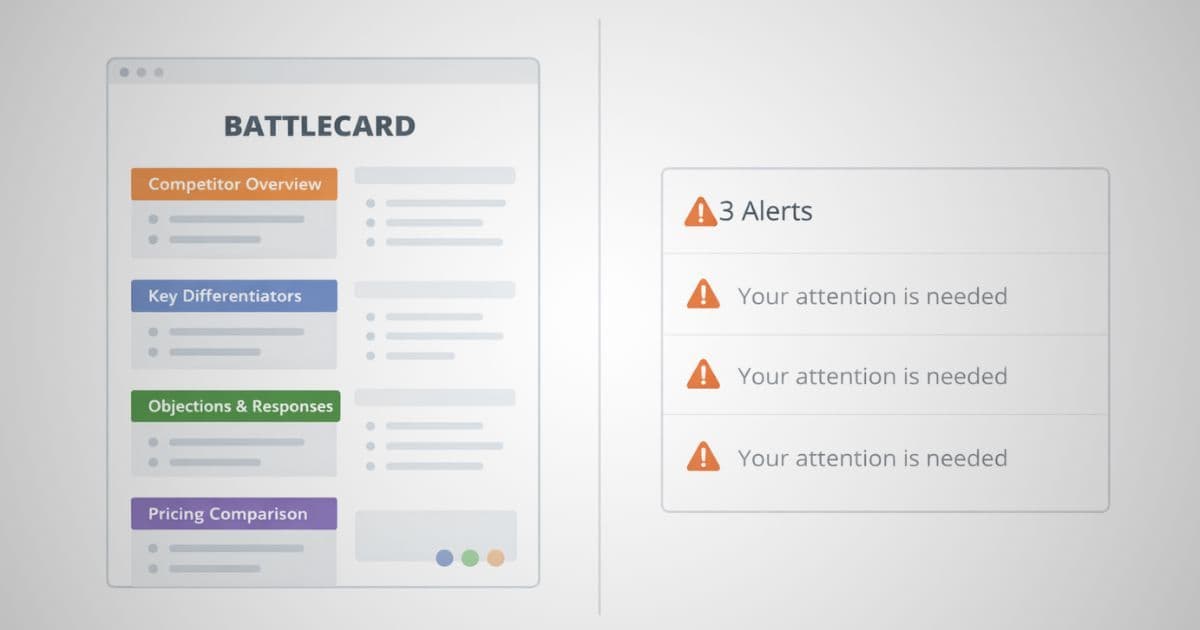
Palrox handles the monitoring and alerting layer well. Where it does not go deep is in sales enablement — battlecards, deal-specific intelligence, and CRM integration. If those are active needs for your team, you may want to evaluate Palrox alongside a tool like Klue that handles the enablement layer.
For a direct comparison, read Palrox vs Klue: competitor monitoring tool comparison.
Enterprise with a Dedicated CI Team: Supplement, Not Primary
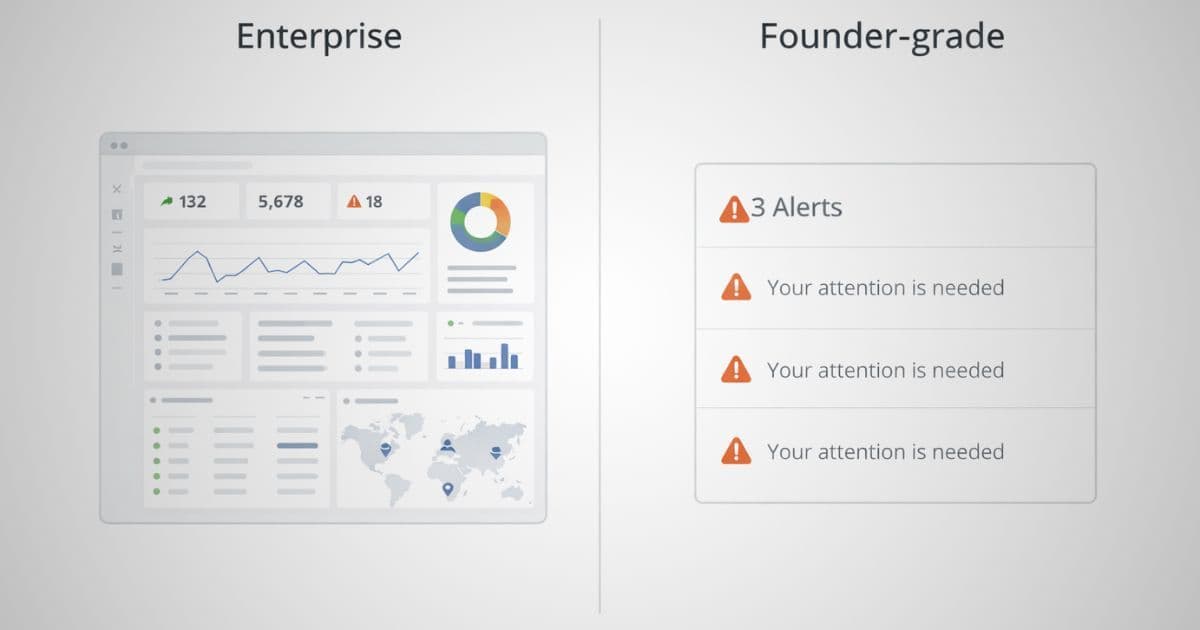
If your company has a dedicated competitive intelligence analyst or team, Palrox can supplement your existing stack but is unlikely to replace your primary CI platform.
Enterprise teams sometimes add Palrox alongside Crayon because it delivers page-level alerts faster, without routing through an analyst first.
Enterprise CI platforms like Crayon aggregate data from more sources, integrate with more internal tools, and are built around the assumption that a person's job is to process and distribute competitive intelligence. Palrox is built around the assumption that the person monitoring is also the person deciding.
That said, some enterprise teams use Palrox's page-level monitoring alongside a broader CI stack because it is fast, specific, and does not require an analyst to process before the signal is useful.
For a comparison with Crayon, read Palrox vs Crayon: competitor monitoring tool comparison.
Agencies: Moderate Fit
If you run a strategy or marketing consultancy and track competitors on behalf of clients, Palrox can work depending on the engagement type.
For clients on ongoing retainers where competitive monitoring is part of the deliverable, Palrox is a practical and affordable tool. You can set up monitoring for each client's competitors and include the weekly summary or a PDF report as part of your regular reporting.
For one-time competitive audits, the ongoing monitoring model is less relevant. You pay for a month, do the analysis, and move on. That is fine, but it is not where Palrox is most valuable.
The One-Question Test
If you are still not sure whether Palrox is right for you, answer this question: In the last six months, have you missed a competitor move that affected a deal, a product decision, or a positioning choice?
If yes, Palrox is probably worth trying. The Starter plan is $29 per month and takes 10 minutes to set up. If you catch one meaningful signal in 30 days that you would have missed manually, the tool has paid for itself in intelligence value.
The right competitor monitoring tool is the one that matches your stage. For most founders and early-stage teams, Palrox is the fastest path to actionable competitive intelligence.
About the Author

Mei Lin Tan
QA specialist
Mei Lin Tan
QA specialist
Mei Lin is a QA specialist at Pagezii ensuring product reliability through rigorous testing, clear bug reporting, and quality assurance processes.
Frequently Asked Questions
Founders and product leads at early to mid-stage B2B SaaS companies get the most consistent value. They have three to ten competitors worth watching, limited time for manual competitor tracking, and a direct need for signals that inform pricing, product, and positioning decisions.
Audience Context
For buyers close to a decision who want a straight answer on fit. They care about honesty — they are skeptical of tools that claim to work for everyone.
Related Insights
- 30 Days of Automated Competitor Tracking Results — Proof of value before you fully commit
- Pagezii vs Crayon: Which Tool Fits Your Stage — Side-by-side for founders vs enterprise teams
- Pagezii vs Klue: Monitoring vs Battlecard Tools — Right tool depends on your sales team size
- Replace Your Competitor Spreadsheet in One Day — How to migrate if Pagezii is the right fit
- The Hidden Cost of Manual Competitor Tracking — What you have been losing without knowing it
References
- Info-Tech Research Group. (2026, February 11). Sales teams lose competitive deals without disciplined competitive intelligence.
https://www.infotech.com/research/sales-teams-lose-competitive-deals-without-disciplined-competitive-intelligence-according-to-i - GTMnow. (2021, January 14). 5 best practices for using competitive intelligence in sales enablement.
https://gtmnow.com/sales-enablement-competitive-intelligence/ - SiftHub. (2026, March 4). Competitive enablement: What top sales teams know.
https://www.sifthub.io/blog/competitive-enablement - User Intuition. (2026, March 3). Market intelligence: The complete guide.
https://www.userintuition.ai/posts/market-intelligence-complete-guide/ - MixBright. (2026, February 23). Market research and intelligence: Complete 2026 guide.
https://mixbright.com/market-research-and-intelligence-guide/
Disclaimer
This article is provided for informational purposes only. Pagezii aims to share practical insights on competitor tracking and market intelligence but does not guarantee completeness, accuracy, or specific business outcomes.